


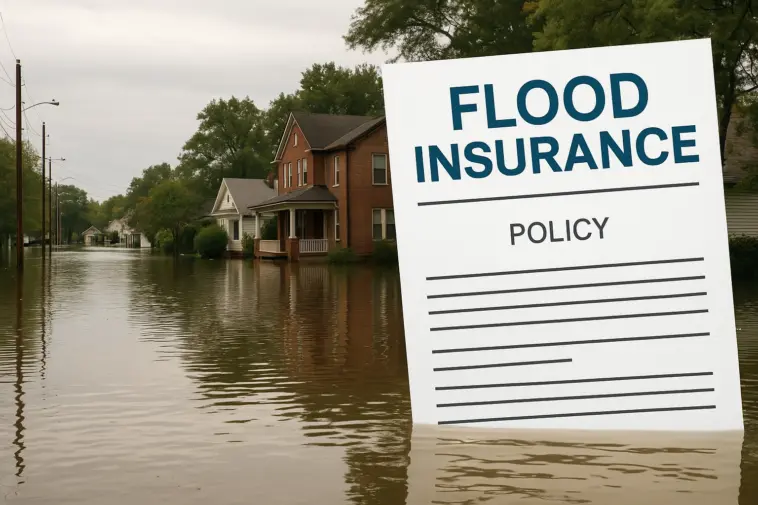
For hundreds of thousands of homeowners throughout america, flood insurance coverage is just not non-compulsory—it’s a
authorized requirement tied on to their mortgage. That requirement is fulfilled nearly
solely by the Nationwide Flood Insurance coverage Program (NFIP), a federal
program managed by FEMA. However with lawmakers gridlocked, the NFIP faces one other looming
expiration. If it lapses, the fallout might be rapid and extreme for housing transactions
in flood-prone areas.
Why Flood Insurance coverage Issues for Mortgages
Federal legislation requires flood insurance coverage for any federally backed mortgage secured by property
in a FEMA-designated Particular Flood Hazard Space. With out insurance coverage, these loans
can’t shut. Which means if the NFIP stops writing new insurance policies, mortgage closings in
hundreds of communities will grind to a halt.
Owners with present NFIP policies would stay lined throughout a lapse, however anybody
attempting to purchase, promote, or refinance in flood zones can be caught.
The Scale of the Subject
- Over 5 million policyholders depend on NFIP protection.
- NFIP covers about 95% of all residential flood insurance coverage within the US.
- Common annual premium = roughly $888, although charges range broadly by threat zone.
- About $1.3 trillion in property are insured by NFIP.
Impression on Patrons and Sellers
A lapse in NFIP doesn’t simply have an effect on floodplain owners—it will possibly ripple by total
regional housing markets. For instance:
- Patrons: With out flood insurance coverage, lenders can’t finalize mortgages,
leaving would-be owners stranded. - Sellers: Owners might even see offers collapse, miserable property values
in flood-prone neighborhoods. - Refinancers: Owners seeking to refinance for decrease charges or cash-out
choices could also be blocked with out energetic protection.
Instance State of affairs: The Stalled Closing
Think about a household in Louisiana buying a $250,000 dwelling in a FEMA flood zone. They’ve
locked in a 30-year fastened mortgage at 6.4%. With out NFIP insurance coverage in place, the lender
can’t legally shut the mortgage. If the NFIP lapses, that deal is suspended indefinitely,
even when each purchaser and vendor are prepared.
Financial Ripple Results
In accordance with actual property teams, even brief NFIP lapses can delay or derail tens of
hundreds of dwelling gross sales. In 2019, a quick NFIP shutdown put an estimated $1
billion in actual property transactions in danger monthly.
Past particular person consumers and sellers, native economies endure from misplaced commissions,
diminished property tax income, and suppressed dwelling values.
Insurance coverage Market Options?
A rising non-public flood insurance coverage market exists, however it’s nonetheless comparatively small and
uneven. Many non-public insurers solely cowl higher-value properties or are concentrated in
sure states like Florida. For many People in FEMA flood zones, the NFIP stays
the one viable possibility.
🔮 What’s Subsequent for the NFIP?
Congress has reauthorized the NFIP greater than 20 instances since 2017, usually by
last-minute extensions. Lawmakers are below stress to reform this system, which is
billions in debt because of repeated disasters. Proposals embody:
- Shifting extra threat to personal insurers.
- Updating FEMA flood maps to replicate local weather dangers extra precisely.
- Elevating premiums in high-risk areas to make this system solvent.
Key Takeaways
- The NFIP is crucial for mortgages in flood-prone areas.
- If it expires, hundreds of dwelling gross sales and refinancings will stall instantly.
- Owners with energetic insurance policies stay lined, however new transactions freeze.
- Non-public flood insurance coverage is rising however can’t exchange NFIP at scale but.
- Congress should act quickly to stop disruption within the housing market.
Sources: FEMA, Nationwide Affiliation of Realtors, Congressional Analysis Service, Bloomberg, Reuters.
